Raga, Timbre and Translation
What survives, and what quietly disappears, when raga, ghazal and Sufi forms pass through production systems built on other assumptions — from setting Khusrau and Kabir to producing raga fusion albums.
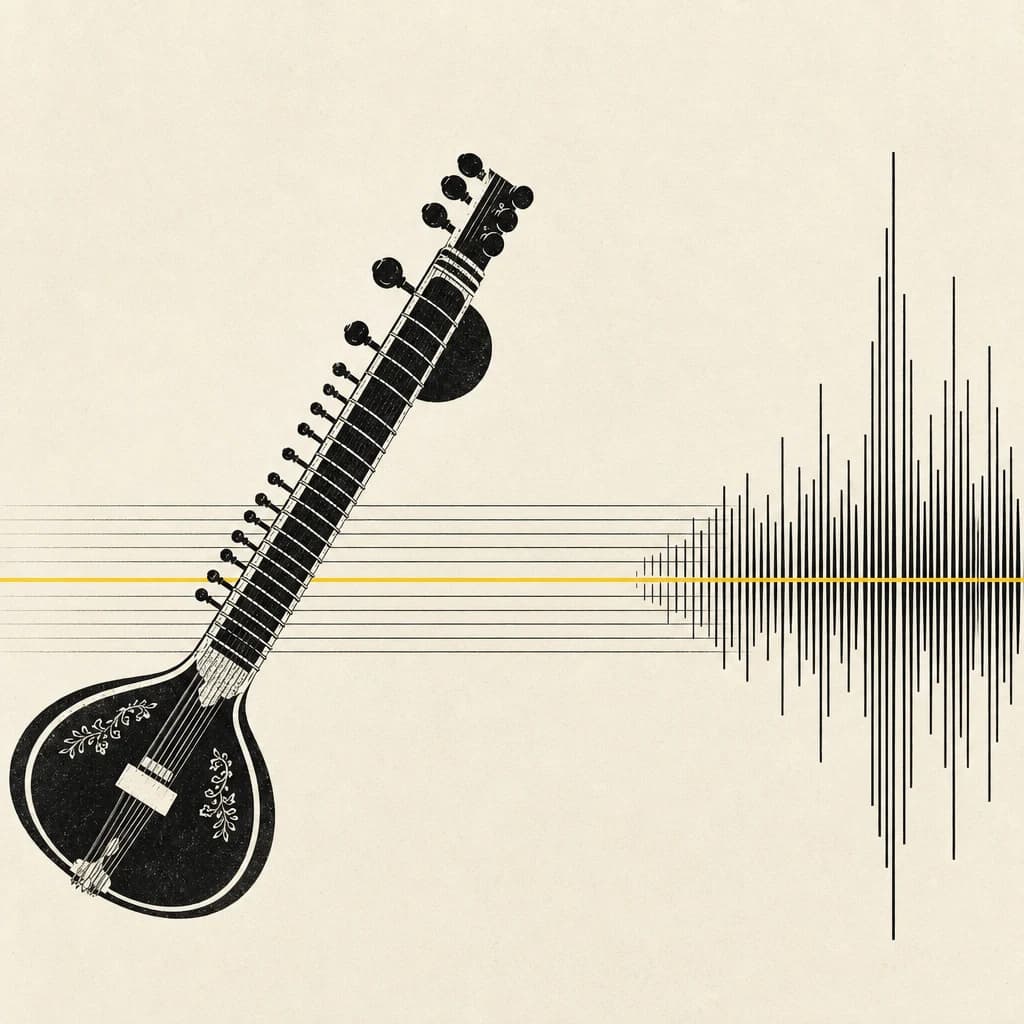
I spend my working life carrying music between two systems that were not designed to meet. On one side: raga, ghazal and Sufi devotional forms — traditions I set and produce at Poppy Seed Music, and whose history I traced in a book, A Concise History of Eastern Music. On the other: the modern production stack — DAWs, piano rolls, sample libraries, mastering chains — whose assumptions I know from the inside as an engineer and as someone who builds production software. Every release is a translation between the two, and translation is never neutral. This essay is about what the tools preserve, what they quietly lose, and what a producer can do about the difference.
I want to be precise rather than romantic about this. The claim is not that technology ruins traditional music — our catalog is a long argument against that despair — but that production systems embed assumptions, and unexamined assumptions end up doing the arranging for you. My first book, Foundations of Music Technology, argued that classical theory and digital workflows belong in one curriculum; this essay is the working version of that argument, written from the desk where the two actually meet.
The grid and the meend
Open a piano roll and you have accepted two propositions before playing a note: pitch is a set of discrete rows, and time is a grid. Both are wrong for this music. The life of a raga phrase is largely between the rows — the meend, the continuous glide that connects one note to the next; the ornament that leans on a pitch before resolving. Draw a raga phrase as blocks on a grid and you have transcribed the skeleton and discarded the voice.
In practice this decides my production order. Phrases that carry the rāg's identity are performed — sung or played, or shaped by hand with continuous pitch — never stepped in. The grid is reserved for what the grid is good at: rhythm patterns, the electronic scaffolding. In the Sitar Wave studies the whole experiment was holding that line — the sitar plays the argument as a lead voice while the chillwave production builds the room it plays in. The moment the sitar gets quantized into the scaffolding, it stops being a voice and becomes a preset.
Twelve rows are not enough
Beneath the grid sits a second assumption: twelve equal-tempered pitches. Indian classical practice hears more finely than that — intonation shifts with the rāg, and the identity of a note is partly how it is approached and where it sits against the drone. Equal temperament flattens those distinctions, and every synthesizer default and pitch-correction preset quietly reasserts the flattening.
The drone is the working answer. Against a tanpura or a sustained tonic, a singer or instrumentalist tunes by ear to the rāg rather than to the keyboard, and the production's harmonic layer has to be built to leave that space open. It is one reason a setting like our Mora Saiyaan, in Khamaaj, keeps the harmony sparse: dense equal-tempered chords do not accompany a rāg so much as outvote it.
What the ghazal asks of an arrangement
Forms carry structure the way instruments carry timbre. A ghazal is a chain of self-contained couplets, each turning on its final phrase — and that turn, not a chorus, is the unit of drama. Setting Ahmed Faraz's Rangish Hi Sahi, the arrangement's whole job was to stay out of the poetry's way until the turn of each sher, and then to open slightly underneath it. Verse-chorus templates, drop-based builds, the four-bar loop logic that production tools make frictionless: all of it actively fights this form.
The same discipline held for Kabir. His plainness is the point — bhakti poetry that says everything in the fewest possible words — so our setting of Re Bande keeps the voice forward and the texture behind, and resists every professional instinct to thicken. Knowing what a form is protecting tells you what the production must not do. That knowledge does not ship with any tool, which is why we study and credit the poets — Nasir Kazmi, Faraz, Shiv Kumar Batalvi, Sahir Hoshiarpuri among them — as writers, not as source material.
A 700-year-old text is not content
The oldest words in our catalog are Amir Khusrau's. More Piyā Ghar Aae sets a text roughly seven centuries old that has never left the living repertoire — singers have carried it continuously from his era to this one. Producing it, the question was never how to modernize it; the tradition does not need our rescue. The question was what the modern layer could offer that the tradition would recognize as hospitality: space, clarity, and a lyric video that puts the words themselves on screen.
This is where the translation metaphor earns its keep. A translator's characteristic failure is not mistranslation; it is producing something fluent in the target language and empty of the source. Production has the same failure mode — the fusion track that is fluent global pop with a sitar sample where its subject should be. The safeguard is unglamorous: know the source form well enough to be corrected by it.
Timbre is the memory
Timbre carries more cultural information than pitch does. A sampled sitar plays the right frequencies with none of the behavior — the sympathetic strings answering, the chikari strings punctuating, the way a note is struck and then bent into the next. Sample libraries preserve the snapshot and lose the grammar, because the grammar lives in performance decisions a library cannot anticipate.
Writing the history book sharpened this for me: instruments are archives. A timbre encodes generations of decisions about material, tuning and technique. When a production system reduces an instrument to a patch name in a menu, that archive is flattened into a flavor. The practical response in our work is to give the instrument the role its tradition gave it — the sitar as a voice with an argument, not garnish over a beat — and to let its real behaviors, noises included, survive into the mix.
Translation, not conversion
Album scale is part of the translation too. Raga performance thinks in long spans — a slow unfolding that a three-minute single simply amputates — which is why our raga fusion work shipped as full albums, Talash and Neo Raag, each built to be heard as one continuous span. Choosing the container is a translation decision of the same order as choosing the tuning: the form dictates, the format follows.
Conversion is lossless only for file formats. For music, every crossing between systems is translation, and translation done well is a creative act with a direction: you must decide which language is the source. In our catalog the tradition is the source; the production stack is the target language, stretched where it needs stretching — grids overridden, temperament loosened, forms respected over templates.
The tools will keep changing, and their assumptions will keep hiding inside the improvements. The work — for producers, and for those of us who also build these systems — is to keep the assumptions visible and negotiable. What technology preserves is what its users insist on preserving. Insisting is the job.